My parents tried very hard to be good parents. That’s a sentiment that goes without saying for most people, but it’s something that I didn’t fully appreciate until I was grown and my parents were no longer around for me to acknowledge.
My parents were married in 1952. My dad was a Korean War veteran from Detroit whose college education in accounting was interrupted by the draft. My mother was a high school dropout from southeastern Kentucky who was working in a steam laundry. (How they met, courted and married is material for another blog post.) Neither one was, shall we say, sophisticated.
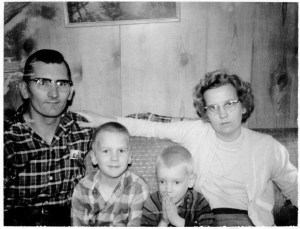
The Matlow family in the early 1960s taken with a newfangled camera called a “Polaroid.” I appear to be in prayer about something.
The summer I turned 5 the family, which included my brother, who was three years older than me, moved from a row house in Cumberland, Kentucky, to a suburban home in South Bend, Indiana. My dad was 33 and my mom was almost 35. It wasn’t quite “The Beverly Hillbillies” as we had no “cee-ment pond,” but they did leave Appalachia for a home in the land of “Leave It to Beaver” and “Father Knows Best.” Those TV shows, with June Cleaver and Margaret Anderson fixing dinner in pearls and high heels, were presented to America as real life. If you were living in this new post-war era of tract houses and garages and back yards, this was what your life was supposed to be like.
Can you remember what your life was like when you were in your early and mid 30s? I think back to what was going on in my life, with the pressures of work and family, and think to myself, this is the stage of my life my parents were in during the three years we lived in Indiana. They had been married about 10 years and uprooted their lives to provide a better one for their children.
Through the lens of 20/20 hindsight, I can tell how hard they tried. One thing they did was buy a console stereo. That was nothing unusual by itself. Advancement in technology, with something the Japanese invented called “transistors” replaced tubes in radios, and 33 rpm records replaced the old 78s. It was a revolution in home entertainment. What was unusual was what they purchased to play on their new stereo. There was a multi-album collection of classical music entitled “The World’s Most Beautiful Music.” There were show tunes: “West Side Story,” “Camelot,” “Brigadoon.”
This was not my parents’ music. She was a lifelong devotee of country music and gospel quartets, and the radio that played in the house in the mornings provided the music of Frank Sinatra and Perry Como. Decades later the light bulb went on over my head: they were trying to do the right thing and provide culture for their sons. And it worked, actually. I can’t tell you how many times I listened to the original Broadway soundtrack of “West Side Story” and “Camelot,” following the story in the liner notes. And one of my two jobs today is doing marketing for the Spokane String Quartet.
But the music is just half the story. The other half comes courtesy of letters from Encyclopedia Britannica that I found after my mother died. I mentioned that she dropped out of high school and went to work during World War II. An older cousin told me that Mother’s older sister was considered to be “the smart one” who received favored treatment from her parents, while my mother didn’t get the encouragement. But my mother wanted to be a better person. When we lived in Indiana, she went to night school and earned her GED. The whole family went downtown on those nights and had dinner at McDonald’s, and my dad took me and my brother to the library to read and check out books while my mother was in school.
In the summer of 1960, while we were still in Kentucky, my parents purchased a set of Encyclopedia Britannica. The contract says the purchase price was $434 (a small fortune in 1960 dollars), payable $10 down and $18 a month. With the encyclopedias came a sheet of “Library Research Service” stamps, each good for a custom research report prepared especially for you.
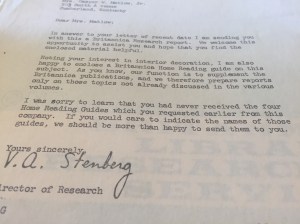 When I was going through these old papers that my mother retained over the next half century and four different houses, what brought tears to my eyes was a letter from V.A. Sternberg, director of research at the Encyclopedia Britannica Library Research Service in Chicago. “Dear Mrs. Matlow,” said the letter dated Feb. 6, 1961, “In answer to your letter of recent date I am sending you with this a Britannica Research report.” Still stapled to the letter was a 21-page typewritten report on “Home Freezing of Foods.” The letter continued, “Noting your interest in interior decoration, I am also happy to enclose a Britannica Home Reading guide on this subject.”
Then came the kicker: “I am sorry to learn that you had never received the four Home Reading Guides which you requested earlier from this company.” To sum up, here was a high school dropout in Appalachia with a new set of encyclopedias that were purchased to help provide a better life for her children. But she wanted to be a better person as well, so she ordered some educational materials, but they never came. Can you imagine the disappointment of a person who took the time to craft a letter to the big company seeking knowledge, checking the mailbox every day, only to have the materials never arrive? But Mother didn’t give up. She requested another publication, and happened to mention the earlier request. And along with the interior decoration guide (maybe to make your home look like the Cleavers’ home?) were publications on business law and religions of the world.
Our family life never turned out like Beaver and Wally’s, but in reality no one’s life ever does. But through the dusty publications and letters kept in a box in the closet, I can say for a fact that it was not because my parents didn’t try. And I am thankful to them for that.
 Florida Refugee