Garden Envy nothing to be trifled with

I don’t know if there’s been an official designation from the American Medical Association or any off-label uses of prescription drugs to treat it, but I will admit that I have G.E. That’s Garden Envy. As in, “Hi, my name’s Garry and I have Garden Envy.” “Hi, Garry!”

I’ve always enjoyed gardening over the years, but lately it’s reached epic proportions. I’ve become obsessed with having a bigger and better garden that will draw the attention of the local garden club’s annual tour of homes. It’s like when the serpent told Eve, “Eat of this fruit and your garden will be the best in all of creation.”

Things started out innocently enough and took a while to develop. When Annie and I  moved into our house in Spokane 22 years ago, the yard, like the house it surrounded, was a giant reclamation project. The area between the dilapidated privacy fence and the alley was an “out of sight, out of mind” area and the weeds stood four feet tall. Garbage had been dumped in one section, and for years we pulled tin cans and broken glass out of the ground as we tried to clean it up. There were out-of-control volunteer trees and intentionally planted trees in some prime gardening spots.

Our first few years were spent working on the lawn. That was the “gateway drug” to gardening. Before long, keeping the dandelions under control just wasn’t providing enough satisfaction. I had been wrestling with a leaky pond and water feature for a number of years, but never could get the cracks sealed so it would consistently hold water. So I decided to to poke some holes in the bottom and use it as a giant planter. We bought a load of manure and topsoil and expanded the garden area around the former pond with what was left over after the pond was filled in. I bought wall bricks and built a wall around the garden to keep the grass at bay. A few years later I added a 2×8 elevated planter box to make it easier on my aging back to harvest vegetables. And the joys of composting became rather addicting.

We always had flowers to look at as we entered or left the house, but never spent a lot of time gazing at them. We always went to Duncan Gardens or the Gaiser Conservatory at Manito Park if we wanted to do that. But that was before I came down with G.E.
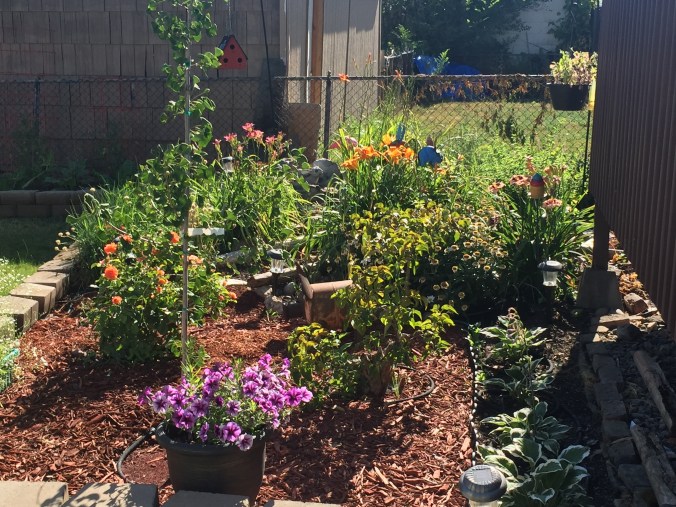
Garden 7-22-17

Our “Not Quite an English Garden” is in the foreground, while the Rock Garden is in the background in this picture taken July 22.

It started out innocently enough. One day last December my friend and co-worker Leslie Woodfill came into the office and remarked, “My whole kitchen smells wonderful from the blossoms from my Meyer lemon tree!” What was that? It was like 20 degrees outside with a foot of snow on the ground, and she had a citrus tree in bloom? Her lemon tree was growing in a pot in her kitchen, and when the weather was warm she moved it out to the porch. And she made lemonade with the lemons!  I had to have one! Thanks to Jeff Bezos, no one every has to leave their house ever again, so I went on Amazon.com and ordered me one live Meyer lemon tree that was delivered to my office, already potted and everything.

That was just the beginning. I commented that it looked like she had a lot going on in her back yard, and she showed me pictures of what it looked like in the summer. “Wow,” I said. “That looks just like an English garden! I always thought it would be neat to have one of those!” And my Garden Envy kicked into full bloom. Now, it never occurred to me that a English garden typically was located on an English estate substantially larger than the 50×100 lot that our house sits on. I soon hatched plans to expand the rock garden (home to the former leaky koi pond) to the west in a 10×10 plot in front of our deck. There was some shade for a row of hostas, which never had done well in the too-sunny front yard, and I was thinking a nice park bench might be a nice addition so we could sit and enjoy the garden. Unfortunately, with the ginkgo tree and lilac bush already in the expansion area, the English garden quickly got scaled back. But with an additional rose bush, some potted flowers, some red bark and an expansion of the garden wall, it looked pretty darn good. I added a hose irrigation system from gardeners.com to keep it looking nice all summer long.

Like anyone in the throes of Garden Envy, I couldn’t let it rest. Leslie looked at a photo of the lilies in the rock garden, and said they needed to be divided this fall. She said I should be thinking of places in the yard where I wanted to plant them. Hmm, I thought. We could put some in front of our front porch, but that wouldn’t be nearly enough room. We have trouble with things growing well there, anyway. That started me thinking again. My old friend, the wall bricks from Lowe’s, served me well in the back yard. I decided to have a 12×4 raised bed around our flagpole, and add the same color bricks in front of the front porch to allow for a layer of good dirt for planting. While Annie and I were still trying to figure out when I would have time to do the work, they went on sale and I was able to buy the 84 bricks AND have them delivered for what I originally planned to spend for just the bricks. I can advise other aging baby boomers, if you have the opportunity to have building materials delivered, instead of loading them into your cart, then loading them into your vehicle, then unloading them at home, then by all means do it.

Annie and I spent a Saturday and a Sunday afternoon digging up sod and positioning bricks, and two Saturdays later we spent six hours in the sun moving two-and-a-half yards of dirt into into the two new raised beds. We ordered the dirt from the Spokane Boys nursery, and they dumped it in the front yard right where we needed it. I had done the math to calculate the cubic footage of dirt required, and it would have worked out to something like 67 of those big bags of topsoil at Lowe’s. Which we would have had to have moved something like three times to get into position in the yard.

All that remains now is dividing and transplanting the lilies, adding some tulips and other early bloomers, and waiting for spring. All that remains … or is it? “Hi, my name’s Garry, and I have Garden Envy.” “Hi, Garry!”
 

Fake news, fake science and the space program

I’ve been called a lot of things in my lifetime, but the name that gives me the most joy is “Grandpapa.” My grandson Ashton, who turns 6 on Wednesday, gave me the name and his little sister Miya calls me that as well. I only knew one of my grandfathers. My dad’s father died when I was a year old, but my maternal grandfather was with us until I was 20.

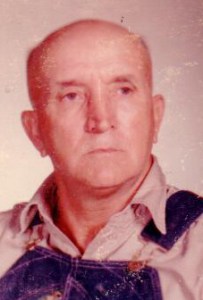
Beckham Stanley

Beckham Stanley was as country as they came. He was a preacher in southeastern Kentucky and was a man who called it as he saw it. Being a man of God, there’s a lot he wouldn’t like about our current president, but there were a lot of qualities that he would respect. Take their shared conviction that we are being deceived by fake news, for example; or more accurately, fake science.

One of the most embarrassing times in my mother’s life was the day in the spring of 1972 when she received a newspaper clipping in the mail from my grandmother. “County Minister Believes No One Has Been To Moon,” said he headline. “People Are Being Tricked,” read the “kicker” subhead up above. What apparently was a dark family secret was now out there in black and white for all the newspaper readers in Pulaski County, Kentucky, to see. I guess the one saving grace was that Al Gore hadn’t invented the internet yet.

I grew up in Brevard County, Florida, in the shadow of the Kennedy Space Center.  So of course I knew that man had walked on the moon. But apparently my grandfather had been telling the members of Grave Hill United Baptist Church in Tateville otherwise, and he said “between 90 and 95 percent of the adult members of his church agree with him.” That’s according to the story by Bill Mardis, the city slicker reporter from nearby Somerset who came to visit and brought news editor Don White with him as his witness. I’m not sure what they expected to encounter when they met my grandfather, but I believe they found something other than what they anticipated.

The story was actually quite respectful. “There was no trickery in our approach to the old preacher,” Mardis wrote. “We told him that we don’t agree with his philosophy that man has never made footprints on the moon. However, we revealed our respect for his right to believe as he does, conceding that there a a number of persons in Pulaski County who subscribe to the same theory.” My grandfather was unwavering in his conviction. “I just don’t believe they went there,” he said. “They can take these trick cameras and show anything they want to.”

He said his five children all disagreed with him on the subject. “We just don’t discuss it,” he said. “They know what I believe and I know what they believe, and I don’t try to change their mind.”
Despite my mother’s fears of what others might think “if this got out,” my grandfather was no crackpot and didn’t come across as such to the two jaded newsmen. They let him him have his say.

“I’ve got a deep conviction about the Lord and the Bible and a strong faith in God,” the preacher mused. “I don’t compromise.”

“I know that science has done miracles, but you can’t believe all that it teaches and still believe the Bible. I’m gonna take the ol’ Word of God,” he said in a tone of voice that showed strength of character.

“I can’t tell you what the moon or sky is made of,” he mused, “but it’s the handiwork of God.” He scoffs at reports of mountains, caves and possible volcanic eruptions on the moon.

“God will take care of man when he gets too far in His business,” Rev. Stanley predicts. “God created both Heaven and Earth.”

The old preacher believes that “messing” with the moon has already affected the earth. He thinks man ought to forget about the moon and take care of things here on earth.

“We’ve had practically no winter at all,” he commented, referring to the unusually mild season just past. 

Mentioning the billions and billions of dollars spent on the space program, Rev. Stanley expressed an opinion that it’s all a big waste. 

“And they talk about poverty,” he almost sneered.

Despite his reluctance to believe that man walked on the moon, I was impressed with his conviction 44 years ago that man’s activities was contributing to the earth’s changing climate, and that the government was spending billions and billions of dollars elsewhere that could be put to better use lifting people out of poverty.

He discussed other issues with the reporters while they waited for a brief rain shower to stop so he could return to his task of painting the church steps. He posed for a picture, and then it was time for the visitors to wrap things up.

Rev. Stanley is not ashamed of his convictions.

“If anybody wants to talk to me, tell them to come on down,” he remarked as we got into the car to leave. “I’ll get down the Ol’ Book and discuss it with anybody.”

He started using the paint brush again, measuring each stroke carefully. A painter by trade would have been proud of the job.

There seemed to be a smile on the preacher’s face … a look of contentment. His undying faith that “the earth is the Lord’s and the fullness thereof” gives peace to his soul.

It took us to the moon, but could you fit it in a toilet?

When’s the last time you dropped a supercomputer in the toilet? Or cracked the data entry interface for a supercomputer? Or how about put a supercomputer through the laundry in the back pocket of your blue jeans? I’ve never done any of these, but I can attest that in my lifetime computers have come a very long ways from what was depicted in the movie “Hidden Figures” to the device saddled with “phone” as part of its name.

Growing up in the shadow of Kennedy Space Center, computers were always a part of our consciousness. They were just never something that regular people had much to do with; they were the realm of engineers who plotted trajectories and other feats that took us to the moon. My dad was an auditor, and to him a spreadsheet was a very large piece of paper with numbers written  in pencil in a lot of little boxes. If there was a mistake in one cell, out came the eraser and numbers were revised across the spreadsheet. He seemed to enjoy this kind of auditing work, at least until Alzheimer’s began to eat away his brain and he had to take early retirement.

The first computer I ever held in my hand was what we today call a “pocket calculator.” You can get one of those for free today with somebody’s business logo on it.  Back in 1972 when Chris Willson brought one to Mr. Mims’ Algebra II class, it was called a “Bomar Brain” and cost $105 (Yes, that’s one hundred and five dollars. Plus tax. In 1972 dollars.) I got to do something with a “real” computer a couple years later in college, when I took a computer sciences course as a foreign language credit for my journalism degree. We had lecture classes taught by a Taiwanese professor, and I had trouble understanding his accent and the material he was teaching. We paid for “computer time,” a valuable commodity, on the university’s mainframe computer as we wrote a simple program on punch cards using the Fortran programming language. The people who mastered that language got their revenge a quarter century later at Y2K, when they were called out of retirement for lucrative jobs teaching computers the year that came after ’99.

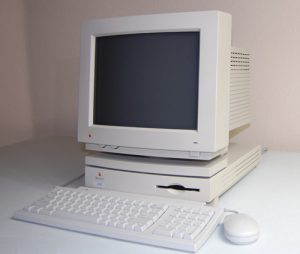
Our first home computer was a Macintosh Performa 467 purchased Jan. 1, 1994.

When I became a newspaper reporter in 1977, our exposure to computers was Compugraphic typesetting equipment. We would write our stories on a long piece of paper not unlike the roll that comes out of a lot of hand towel machines in public restrooms. If we had to insert a paragraph into a story, we would literally “cut” the paper and “paste” the new one in it using rubber cement. That practice gave us the modern day terminology of “cut and paste” and probably gave a lot of reporters a chemical dependency from huffing too much rubber cement (and no, that’s not where the “Huff Post” online got its name). Young women who were very fast typists would spend all day retyping our stories onto long strips of paper about three-quarters of an inch wide that could be read by the Compugraphic equipment, which then output them as type onto photosensitive paper, which was developed, waxed and stuck down on a layout sheet.

Around 1980 the semi-weekly newspaper at which I worked in Wharton, Texas, installed a computer system which consisted of several “dumb” terminals linked to a central computer, which in turn was linked to the Compugraphic equipment. One of my jobs every morning was inserting a 12-inch floppy disk (this was when they were really floppy and not protected by a hard plastic case) into the computer so everyone’s terminals could come to life. You notice the name Compugraphic keeps popping up. They had a virtual monopoly on newspaper typesetting equipment back in that era. A few years later, David Moran, our tech guru at the Attaway Newspaper Group in the Houston suburbs, found out a way to beat the system. He came up with a program that would interface a TRS-80 computer from Radio Shack with the Compugraphic typesetters, making every reporter or editor a typesetter for a fraction of the cost. They were decried as the “Trash 80” by devotees of computers that are also nowhere to be found today, but they taught me a lot about modern-day computing. Plus, I had fun playing games on them when I wasn’t working.

The term “home computer didn’t become ubiquitous until a decade later. We bought our first computer on Jan. 1, 1994, at the Sam’s Club in Daytona Beach. It was a Macintosh Performa 467, which came with 4 megs (that’s megs, not gigs) of RAM and a 160-meg (again, meg, not gig) hard drive. We had decided on the purchase a few months earlier, but had to wait to arrange financing. I spent the fall of 1993 reading MacUser magazines and MacWarehouse catalogs from cover to cover, frontwards and backwards, devouring everything there was to be learned about this new marvel that was joining our household.

So much has changed in the world of computing in the nearly quarter-century since. It’s not just that I’m writing this blog post on a MacBook Pro that’s sitting on my lap while I’m relaxing on my living-room couch. It’s the very nature of how computers (How many people use them to “compute” anything these days?) have changed the very nature of how we live. I heard recently that when we were kids, we would write our deepest thoughts in a diary and get mad if somebody read them. Nowadays, we write them in a blog or on Facebook and get mad if somebody doesn’t read them.

The “more computing power than took man to the moon” was last used to describe a home device about 20 years ago, which as I recall was the Palm Pilot (one more device for the scrap heap of technology history). Nowadays, your iPhone (or Android device if you don’t appreciate the finer things in life) is an honest-to-goodness supercomputer. Just be careful if you’re holding a supercomputer in the palm of your hand while you’re near a toilet. At least today, the bag of rice it will take to dry it out isn’t anywhere near as large as the one that would have been required in 1969.


Whatever happened to the Old West?

We moved to Florida the summer I turned 8 years old. It goes without saying that Florida was a much different place in 1964. But unless you experienced Florida before the arrival of Walt Disney World and everything that followed, you have no idea how much.

The Interstate Highway System was still in the early stages of construction, so highways went from town to town and through, not around them. Travel was at a much slower pace, and tourist attractions were something you might encounter along the side of the road. There were still major tourist attractions spread across Central Florida; Walt Disney didn’t invent the sunshine, after all. But most of those are gone now, lost to the inability to compete with the glitz of Mickey and friends.

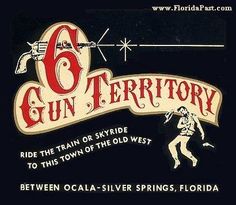
6 Gun TerritoryOne of my favorite attractions was Six Gun Territory just east of Ocala. It was a replica of an Old West town, where you’d stroll the dirt streets and visit the saloon, the general store, the school house, and so on. The chief attraction was live gunfights on the street with lawmen and desperadoes shooting very loud blanks at each other from their six-shooters and dying some Hollywood-worthy deaths.

Six Gun Territory isn’t there anymore. I believe I heard it’s an RV park now. Of course, Six Gun Territory was never really there; back in the 1880s there wasn’t much south of the Florida Panhandle except alligators and mosquitoes and a few coastal communities. But what if Six Gun Territory had been real? What would it be like today? I think it would have “grown up” to become a place like Wallace, Idaho.

Wallace, just 90 minutes east of Spokane along Interstate 90, is a town that has embraced, rather than run from, its past. Like other towns in northern Idaho’s Silver Valley, Wallace was built on the twin pillars of the Old West’s economy: mining and the railroad. We’ve been to Wallace twice this summer and spent our wedding anniversary there last weekend.

Wallace and Kellogg, the next town to the west, charted different paths when a downturn in the mining industry crippled the local economy. City fathers in Kellogg took advantage of the mountain at their doorstep to develop ski runs and a gondola ride up to the top. There was only one problem. The gondola reached the bottom too far from downtown, and as a result visitors to Silver Mountain had no reason to leave the resort area. As a result, the downtown area became little more than a collection of boarded-up commercial buildings.

OasisOn the other hand, Wallace as a whole has embraced the tourism industry and found success. You might say that’s it’s embraced tourism for a long time; after all, it still had an active bordello downtown until 1988. Yes, 1988. That space is now the Oasis Bordello Museum, with “eye-opening guided tours (and) three floors of historical artifacts.” Those artifacts weren’t dug up, but consists of things that are where they were found when the last of the ladies left in a hurry in 1988.
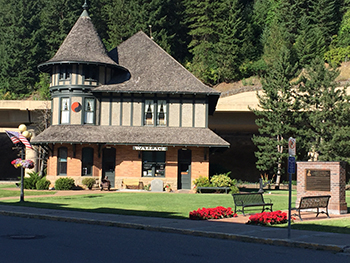
Despite a year-round population of less than 1,000 people, I didn’t see a single boarded-up storefront downtown. It could have turned out much different. A half century ago, the Federal Highway Administration was planning Interstate 90 through the Silver Valley and its initial plan was to take the route through the center of Wallace. The town’s leaders liked Wallace the way it was, and every building in downtown Wallace was added to the National Register of Historic Places. The government was forced to re-route the interstate to an elevated viaduct skirting the northern edge of town. That viaduct famously collapsed thanks to the magic of Hollywood special effects in the 1997 volcano movie “Dante’s Peak.”

DepotToday Wallace is a compact, walkable downtown with something for everybody. There’s lots of brick buildings erected in the aftermath of the Great Fire of 1910. There’s lots of nice touches such as the old First National Bank building with the analog time and temperature sign. The former Northern Pacific Railway depot has been restored and converted into a railroad museum. The day we were there, “Colonel Wallace” was available to give us a personal tour. We stayed in the Ryan Hotel, which is billed as the oldest continuously operating “legitimate” hotel, dating to 1903. The lobby is on the second floor, up some 20 stairs (no elevator), but once there you’re greeted by a sitting room that looks virtually unchanged since the early 1900s. A word of caution: no air conditioning, no television, no radio, again just like the old days. Just down the street is Tabor’s Emporium, with two floors of mid-century modern antiques and collectibles. A block away, at the intersection with the manhole cover (and photo opportunity) designated “The Center of the Universe,” is Johnson’s Gems, featuring handmade jewelry, sports memorabilia and other collectibles.

The Sierra Silver Mine Tour departs from downtown, and lets you go underground for a tour led by a former miner who fires up some of the old equipment to give you a glimpse at conditions several stories underground in earlier times. The Sixth Street Melodrama offers family entertainment as the fair maiden is rescued from the dastardly bad man and the farm is saved. The town also hosts the Wallace District Mining Museum, Silver Streak Zipline Tours, and is the trailhead for hikes up into the great outdoors and the starting point for the Trail of the Coeur d’Alenes, a 70-mile (mostly downhill) paved bicycle and pedestrian trail along a former railroad bed. We had lunch at The Fainting Goat: Wine Bar, Tap Room and Casual Fine Dining. We both had the asparagus and shrimp salad, made with asparagus, shrimp, field greens balsamic vinaigrette, spiced hazelnuts, heirloom tomatoes and poached egg. Yes, in Wallace, Idaho.

I’m not saying that Wyatt Earp would trade in his shot of deadeye whiskey for a glass of Viognier if he were to ride his (Ford) Mustang into Wallace today, but I do think he would be right at home in this modern version of an Old West town.