We moved to Florida the summer I turned 8 years old. It goes without saying that Florida was a much different place in 1964. But unless you experienced Florida before the arrival of Walt Disney World and everything that followed, you have no idea how much.
The Interstate Highway System was still in the early stages of construction, so highways went from town to town and through, not around them. Travel was at a much slower pace, and tourist attractions were something you might encounter along the side of the road. There were still major tourist attractions spread across Central Florida; Walt Disney didn’t invent the sunshine, after all. But most of those are gone now, lost to the inability to compete with the glitz of Mickey and friends.
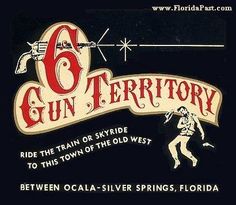 One of my favorite attractions was Six Gun Territory just east of Ocala. It was a replica of an Old West town, where you’d stroll the dirt streets and visit the saloon, the general store, the school house, and so on. The chief attraction was live gunfights on the street with lawmen and desperadoes shooting very loud blanks at each other from their six-shooters and dying some Hollywood-worthy deaths.
Six Gun Territory isn’t there anymore. I believe I heard it’s an RV park now. Of course, Six Gun Territory was never really there; back in the 1880s there wasn’t much south of the Florida Panhandle except alligators and mosquitoes and a few coastal communities. But what if Six Gun Territory had been real? What would it be like today? I think it would have “grown up” to become a place like Wallace, Idaho.
Wallace, just 90 minutes east of Spokane along Interstate 90, is a town that has embraced, rather than run from, its past. Like other towns in northern Idaho’s Silver Valley, Wallace was built on the twin pillars of the Old West’s economy: mining and the railroad. We’ve been to Wallace twice this summer and spent our wedding anniversary there last weekend.
Wallace and Kellogg, the next town to the west, charted different paths when a downturn in the mining industry crippled the local economy. City fathers in Kellogg took advantage of the mountain at their doorstep to develop ski runs and a gondola ride up to the top. There was only one problem. The gondola reached the bottom too far from downtown, and as a result visitors to Silver Mountain had no reason to leave the resort area. As a result, the downtown area became little more than a collection of boarded-up commercial buildings.
 On the other hand, Wallace as a whole has embraced the tourism industry and found success. You might say that’s it’s embraced tourism for a long time; after all, it still had an active bordello downtown until 1988. Yes, 1988. That space is now the Oasis Bordello Museum, with “eye-opening guided tours (and) three floors of historical artifacts.” Those artifacts weren’t dug up, but consists of things that are where they were found when the last of the ladies left in a hurry in 1988.
Despite a year-round population of less than 1,000 people, I didn’t see a single boarded-up storefront downtown. It could have turned out much different. A half century ago, the Federal Highway Administration was planning Interstate 90 through the Silver Valley and its initial plan was to take the route through the center of Wallace. The town’s leaders liked Wallace the way it was, and every building in downtown Wallace was added to the National Register of Historic Places. The government was forced to re-route the interstate to an elevated viaduct skirting the northern edge of town. That viaduct famously collapsed thanks to the magic of Hollywood special effects in the 1997 volcano movie “Dante’s Peak.”
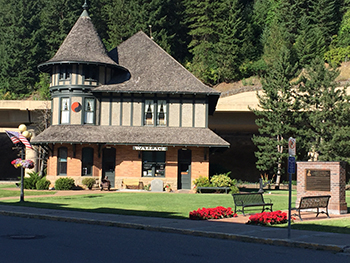 Today Wallace is a compact, walkable downtown with something for everybody. There’s lots of brick buildings erected in the aftermath of the Great Fire of 1910. There’s lots of nice touches such as the old First National Bank building with the analog time and temperature sign. The former Northern Pacific Railway depot has been restored and converted into a railroad museum. The day we were there, “Colonel Wallace” was available to give us a personal tour. We stayed in the Ryan Hotel, which is billed as the oldest continuously operating “legitimate” hotel, dating to 1903. The lobby is on the second floor, up some 20 stairs (no elevator), but once there you’re greeted by a sitting room that looks virtually unchanged since the early 1900s. A word of caution: no air conditioning, no television, no radio, again just like the old days. Just down the street is Tabor’s Emporium, with two floors of mid-century modern antiques and collectibles. A block away, at the intersection with the manhole cover (and photo opportunity) designated “The Center of the Universe,” is Johnson’s Gems, featuring handmade jewelry, sports memorabilia and other collectibles.
The Sierra Silver Mine Tour departs from downtown, and lets you go underground for a tour led by a former miner who fires up some of the old equipment to give you a glimpse at conditions several stories underground in earlier times. The Sixth Street Melodrama offers family entertainment as the fair maiden is rescued from the dastardly bad man and the farm is saved. The town also hosts the Wallace District Mining Museum, Silver Streak Zipline Tours, and is the trailhead for hikes up into the great outdoors and the starting point for the Trail of the Coeur d’Alenes, a 70-mile (mostly downhill) paved bicycle and pedestrian trail along a former railroad bed. We had lunch at The Fainting Goat: Wine Bar, Tap Room and Casual Fine Dining. We both had the asparagus and shrimp salad, made with asparagus, shrimp, field greens balsamic vinaigrette, spiced hazelnuts, heirloom tomatoes and poached egg. Yes, in Wallace, Idaho.
I’m not saying that Wyatt Earp would trade in his shot of deadeye whiskey for a glass of Viognier if he were to ride his (Ford) Mustang into Wallace today, but I do think he would be right at home in this modern version of an Old West town.
 Florida Refugee