When’s the last time you dropped a supercomputer in the toilet? Or cracked the data entry interface for a supercomputer? Or how about put a supercomputer through the laundry in the back pocket of your blue jeans? I’ve never done any of these, but I can attest that in my lifetime computers have come a very long ways from what was depicted in the movie “Hidden Figures” to the device saddled with “phone” as part of its name.
Growing up in the shadow of Kennedy Space Center, computers were always a part of our consciousness. They were just never something that regular people had much to do with; they were the realm of engineers who plotted trajectories and other feats that took us to the moon. My dad was an auditor, and to him a spreadsheet was a very large piece of paper with numbers written in pencil in a lot of little boxes. If there was a mistake in one cell, out came the eraser and numbers were revised across the spreadsheet. He seemed to enjoy this kind of auditing work, at least until Alzheimer’s began to eat away his brain and he had to take early retirement.
The first computer I ever held in my hand was what we today call a “pocket calculator.” You can get one of those for free today with somebody’s business logo on it. Back in 1972 when Chris Willson brought one to Mr. Mims’ Algebra II class, it was called a “Bomar Brain” and cost $105 (Yes, that’s one hundred and five dollars. Plus tax. In 1972 dollars.) I got to do something with a “real” computer a couple years later in college, when I took a computer sciences course as a foreign language credit for my journalism degree. We had lecture classes taught by a Taiwanese professor, and I had trouble understanding his accent and the material he was teaching. We paid for “computer time,” a valuable commodity, on the university’s mainframe computer as we wrote a simple program on punch cards using the Fortran programming language. The people who mastered that language got their revenge a quarter century later at Y2K, when they were called out of retirement for lucrative jobs teaching computers the year that came after ’99.
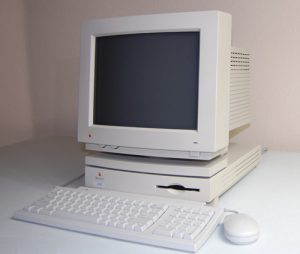
Our first home computer was a Macintosh Performa 467 purchased Jan. 1, 1994.
When I became a newspaper reporter in 1977, our exposure to computers was Compugraphic typesetting equipment. We would write our stories on a long piece of paper not unlike the roll that comes out of a lot of hand towel machines in public restrooms. If we had to insert a paragraph into a story, we would literally “cut” the paper and “paste” the new one in it using rubber cement. That practice gave us the modern day terminology of “cut and paste” and probably gave a lot of reporters a chemical dependency from huffing too much rubber cement (and no, that’s not where the “Huff Post” online got its name). Young women who were very fast typists would spend all day retyping our stories onto long strips of paper about three-quarters of an inch wide that could be read by the Compugraphic equipment, which then output them as type onto photosensitive paper, which was developed, waxed and stuck down on a layout sheet.
Around 1980 the semi-weekly newspaper at which I worked in Wharton, Texas, installed a computer system which consisted of several “dumb” terminals linked to a central computer, which in turn was linked to the Compugraphic equipment. One of my jobs every morning was inserting a 12-inch floppy disk (this was when they were really floppy and not protected by a hard plastic case) into the computer so everyone’s terminals could come to life. You notice the name Compugraphic keeps popping up. They had a virtual monopoly on newspaper typesetting equipment back in that era. A few years later, David Moran, our tech guru at the Attaway Newspaper Group in the Houston suburbs, found out a way to beat the system. He came up with a program that would interface a TRS-80 computer from Radio Shack with the Compugraphic typesetters, making every reporter or editor a typesetter for a fraction of the cost. They were decried as the “Trash 80” by devotees of computers that are also nowhere to be found today, but they taught me a lot about modern-day computing. Plus, I had fun playing games on them when I wasn’t working.
The term “home computer didn’t become ubiquitous until a decade later. We bought our first computer on Jan. 1, 1994, at the Sam’s Club in Daytona Beach. It was a Macintosh Performa 467, which came with 4 megs (that’s megs, not gigs) of RAM and a 160-meg (again, meg, not gig) hard drive. We had decided on the purchase a few months earlier, but had to wait to arrange financing. I spent the fall of 1993 reading MacUser magazines and MacWarehouse catalogs from cover to cover, frontwards and backwards, devouring everything there was to be learned about this new marvel that was joining our household.
So much has changed in the world of computing in the nearly quarter-century since. It’s not just that I’m writing this blog post on a MacBook Pro that’s sitting on my lap while I’m relaxing on my living-room couch. It’s the very nature of how computers (How many people use them to “compute” anything these days?) have changed the very nature of how we live. I heard recently that when we were kids, we would write our deepest thoughts in a diary and get mad if somebody read them. Nowadays, we write them in a blog or on Facebook and get mad if somebody doesn’t read them.
The “more computing power than took man to the moon” was last used to describe a home device about 20 years ago, which as I recall was the Palm Pilot (one more device for the scrap heap of technology history). Nowadays, your iPhone (or Android device if you don’t appreciate the finer things in life) is an honest-to-goodness supercomputer. Just be careful if you’re holding a supercomputer in the palm of your hand while you’re near a toilet. At least today, the bag of rice it will take to dry it out isn’t anywhere near as large as the one that would have been required in 1969.
 Florida Refugee