God Bless America

Has there ever been a picture that you’ve regretted not taking? For me it was in 2001, in those horrible days after 9/11 when every reader board in Spokane proclaimed “God Bless America.” There was a furniture store on Division Street, just north of the river, that posted on their reader board:

GOD BLESS
AMERICA
NEW FURNITURE
ARRIVING DAILY

My thought was, “Thank you, Lord. The world is crashing down around us, but at least we have new furniture.”

My heroes have always been astronauts

(From the archives, a column first published in the The Journal in Friendswood, Texas, April 1, 1982)

Waylon and Willie had a song out a few years ago entitled “My Heroes Have Always Been Cowboys.” It was a melancholy tune, but you could tell from listening to it that the aging singer hadn’t lost his respect for the cowboys he idolized as a youth.

I guess you could say that my heroes have always been astronauts.

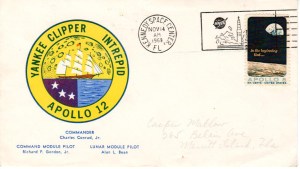
Apollo 12 CoverI was born in the mid-1950s, and the manned spacecraft program grew up as I did. While previous generations of youngsters all wanted to be policemen or firemen, mine was the first to grow up wanting to be astronauts.

And why not? The seven Mercury astronauts captured the imagination of a generation and became America’s Team long before the Dallas Cowboys emerged as a football powerhouse.

I remember a banner headline in the South Bend (Ind.) Tribune from May 1962 that proclaimed, “Carpenter Found Safe on Raft.” It never entered anyone’s mind that the story may have referred to a woodworker missing at sea. Everyone automatically knew it was astronaut Scott Carpenter, whose capsule plunged into the ocean a couple hundred miles off target.

Parents also approved of astronauts as role models for their children. As Tom Wolfe said in “The Right Stuff,” they were all family men shaped into the All-American Boy mold of John Glenn. They all had those Pepsodent smiles and were an extension of the renaissance spirit of John Kennedy’s America.

Kennedy died when I was 7 years old, but the space program continued to thrive. The next summer we moved to Florida and I lived in the shadow of the space center, watching from my front yard as those balls of fire took off into space.

Being a generation in search of heroes, we all had favorite baseball players by whom our spirits rose of fell each summer depending on such things as batting averages.

We also had favorite astronauts. Mine was Gus Grissom. I don’t remember if it was because he looked like my Uncle Ray, or if it was because he was emerging as the “star” of the program, being on the first Gemini flight and scheduled for the initial Apollo mission. I read recently he was also supposed to be the first man on the moon

Of course, that all came to an end when Grissom achieved another “first” in January 1967 when he, Ed White and Roger Chaffee became the first American astronauts to die in the line of duty.

Having your hero up and die on you is a tough thing to handle, especially for a kid. However, after the pain of wondering “Why?” passes, you learn that life goes on despite whatever tragedy presents itself to you.

As the years roll by, the heroes of childhood go by the wayside or are put on a shelf to be thought about on rainy days and the like. When you get older, society tells us, you are supposed to have your life in good ordered not be dependent on others for a role model.

It’s a shame, too. Having heroes gives you an outlet for your imagination and lets you share in somebody else’s triumphs in those times that your own life seems a little on the ordinary side.

As we learned from the recent death of comedian John Belushi, though, there is always the danger of somebody’s hero having “feet of clay.” It’s a powerful responsibility that we place on people we choose for our heroes. Some can handle it, but some can’t.

Gratia Lousma, wife of astronaut Jack Lousma, told the Journal in an interview last year that the men who fly into space aren’t really special people. She said it was just their opportunities that are special.

Some heroes, like Alan Ladd in “Shane,’ are reluctant ones. By having a unique occupation, astronauts will continue to be idolized by many.

As for me, I’ll probably always have sweaty palms and a quickened heartbeat every time I watch a rocket lift off carrying astronauts on another mission in space.

They don’t write ’em like Kris anymore

You don’t get too many chances to see a living legend perform. In the past two years, I’ve been privileged to see James Taylor and Paul Simon perform. If his health holds out, in January I’ll get to see Kris Kristofferson perform in Spokane at the Martin Woldson Theater at The Fox.

IMG_1649_optI have to say “if his health holds out,” because I remember seeing Ray Charles perform with the Spokane Symphony in 2002. He gave a great show, and a couple seasons later the Seattle Symphony had him booked; unfortunately for them, Ray didn’t live that long. And Kris is 82 years old.

I know a lot of my younger friends are saying, “Who’s Kris Kristofferson?” and some of my older ones might even be saying, “Isn’t she one of those self-absorbed sisters on that reality TV show?” For those who aren’t familiar with his work, the former Rhodes Scholar, Army Ranger and survivor of a starring movie role opposite Barbra Streisand is one of the greatest songwriters in the second half of the 20th century. His country crossover hits included the Roger Miller and later Janis Joplin hit “Me and Bobby McGee,” Ray Price’s “For the Good Times,” Sammi Smith’s “Help Me Make It Through the Night,” and my personal favorite, Johnny Cash’s “Sunday Morning Coming Down.”

I once heard “Sunday Morning Coming Down” described as “the greatest hangover song ever written.” These days a country songwriter would write something like “Last night I drank so much beer out of my red Solo cup that I puked until noon.” And probably make millions off of it and be the toast of Nashville. Kristofferson’s songs always had a little more depth.

Well I woke up Sunday morning
With no way to hold my head that didn’t hurt
And the beer I had for breakfast wasn’t bad
So I had one more for dessert

As the story progresses, the songwriter goes for a walk through the neighborhood and “caught the Sunday smell of someone frying chicken, and it took me back to something that I’d lost somehow, somewhere along the way.” As his walk continues, he sees a father and daughter having a good time on the swingset in the park, hears singing coming from a church, and is heading toward home when he hears a “lonely bell” chiming in the distance, “and it echoed through the canyon like the disappearing dreams of yesterday.”

On the Sunday morning sidewalks
Wishing Lord that I was stoned
‘Cause there’s something in a Sunday
That makes a body feel alone.
And there’s nothing short of dying
Half as lonesome as the sound
On the sleeping city sidewalk
Sunday morning coming down.

Pure poetry. Kristofferson said in 2016 that “it was the song that allowed me to quit working for a living.”

Kristofferson still works, though, touring with the late Merle Haggard’s band, The Strangers. When he comes to Spokane in January, I’m sure he’ll be singing the songs I mentioned, made-famous-by-him songs like “Loving Her Was Easier (Than Anything I’ll Ever Do Again)” and “Why Me, Lord?”, and some of Merle Haggard’s hits. And if he needs a duet partner, I’ll be ready.

Remembering when the pen was mightier than the sword

Observer_1980s

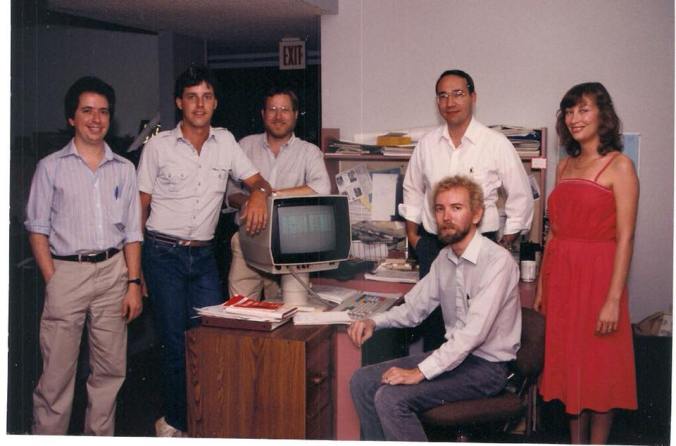
The newsroom crew at the New Smyrna Beach Observer in the late 1980s. Standing are Billy Bruce, Rob Stamp, Cohn Barnes, Jim Jones and Gerri Bauer. I’m seated.

Some wistful memories from Jim Camden in the Spokesman-Review today about the “old days” and newspaper security. I worked in small-town newspapers in Texas when people could (and did) walk in off the street and be in the newsroom, from mentally unbalanced people to gubernatorial and congressional candidates. In New Smyrna Beach, Florida, people could (and did) walk unfettered in the back door, which was right across the street from the ABC Liquor store.

 
If you didn’t want to show your ID badge to security at the Daytona Beach News-Journal, you could enter undetected past the designated smoking area by the loading dock. In Daytona the newsroom was on the second floor, and thankfully we had the advertising department on the first floor as our first line of defense.
 
As Jim says in his piece, “I’ll miss the old open newsroom, but I won’t ever say a negative word about the new one.”

Houston Strong

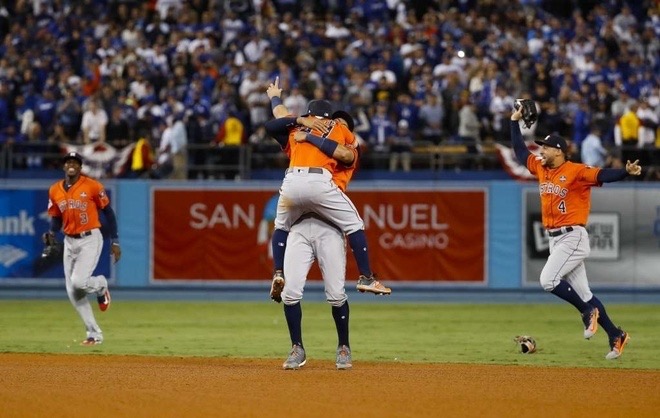
So let’s hear it for the Last-tros, the Disast-ros, the team that lost more than 100 games a year between 2011 and 2013: the 2017 World Series champions. The sleeping giant has awakened; this is a team to be reckoned with.

I’ve been a baseball fan as long as I can remember. My earliest baseball memory was in October 1963, when as a 7 year old I cried like a baby when the Dodgers swept the Yankees in four straight to win the World Series. I picked a bad decade to be a Yankee fan. My hero was No. 7, the great Mickey Mantle, who was well past his prime and literally limping into retirement.

My best friend Clinton Branch was also a Mantle fan. I remember one time when we took Sharpies and turned our white T-shirts into No. 7 pinstriped Yankees jerseys. If that didn’t invite enough ridicule, we then had a two-person parade around the neighborhood for all to see. And we wonder why we were bullied. Back then out-of-market televised baseball was NBC’s Game of the Week on Saturday afternoons with Curt Gowdy and Joe Garagiola. Once the hapless Yankees were actually on and I got to watch them. I remember Clinton blamed me because Mantle homered last time he saw them on TV, but this time his only hit “was a stupid drag bunt.”

I kept the faith with the Yankees through the 1970s, but things started to change with the advent of big-money baseball and George Steinbrenner. I was a traditionalist, and all the change was a little much to handle. Then on Aug. 2, 1979, my last Yankee hero, catcher Thurman Munson, died in a plane crash. I was done. I had nothing left in the tank for the Yankees.

By that time I was living in the Houston area and the Astros were my “National League team.” The succeeded the Mets as the chronic underachievers, playing in, once the Louisiana Superdome was built, what was dubbed “the World’s Smallest Domed Stadium.” But I have good baseball memories from my Houston years, from buying seats in left field for the expressed purpose of heckling inept leftfielder Cliff Johnson, to being there at the stadium on that July night in 1976 when Larry Dierker pitched a no-hitter.

Another special memory was the 1980 season when the Astros won the Western Division and played the Phillies to see who would go to the World Series. I got tickets to the deciding Game 5 and was ready to witness history being made. Nolan Ryan was on the mound. All was right with the world. Houston took a 1-0 lead in the first, but Philadelphia came back with 2 in the second. The Astros tied it in the sixth, then opened up a 5-2 lead in the bottom of the seventh. Just six more outs to go. But the Phillies weren’t finished. Five runs in the top of the eighth to take a 7-5 lead. But wait! Two runs for the Astros in the bottom of the eighth to tie it 7-7. Beer sales were cut off, but there was still pressure-packed baseball to be played. No runs in the ninth, so it was on to extra innings. In the 10th, Del Unser and Garry Maddox both doubled for the Phillies. The Astros were retired in the bottom of the 10th, and the Phillies won their first pennant in 30 years.

It was another 25 years until the Astros made it to the World Series, and 12 years after that until they won it all, in a series much like the Game 5 that I saw in the Astrodome 37 years ago: no lead was ever safe. Even the 5-0 lead in Game 7 in LA wasn’t good enough. We’d seen leads on both sides evapaorate with one swing of the bat multiple times in this series. It was all about the countdown to 27 outs. No rest until then.

Was it “one for the ages”? Not if you’re a fan of excellent pitching. But is was one to relive over and over through a long cold winter, until next March when teams load up and head to Florida and Arizona to start the process again.

Garden Envy nothing to be trifled with

I don’t know if there’s been an official designation from the American Medical Association or any off-label uses of prescription drugs to treat it, but I will admit that I have G.E. That’s Garden Envy. As in, “Hi, my name’s Garry and I have Garden Envy.” “Hi, Garry!”

I’ve always enjoyed gardening over the years, but lately it’s reached epic proportions. I’ve become obsessed with having a bigger and better garden that will draw the attention of the local garden club’s annual tour of homes. It’s like when the serpent told Eve, “Eat of this fruit and your garden will be the best in all of creation.”

Things started out innocently enough and took a while to develop. When Annie and I  moved into our house in Spokane 22 years ago, the yard, like the house it surrounded, was a giant reclamation project. The area between the dilapidated privacy fence and the alley was an “out of sight, out of mind” area and the weeds stood four feet tall. Garbage had been dumped in one section, and for years we pulled tin cans and broken glass out of the ground as we tried to clean it up. There were out-of-control volunteer trees and intentionally planted trees in some prime gardening spots.

Our first few years were spent working on the lawn. That was the “gateway drug” to gardening. Before long, keeping the dandelions under control just wasn’t providing enough satisfaction. I had been wrestling with a leaky pond and water feature for a number of years, but never could get the cracks sealed so it would consistently hold water. So I decided to to poke some holes in the bottom and use it as a giant planter. We bought a load of manure and topsoil and expanded the garden area around the former pond with what was left over after the pond was filled in. I bought wall bricks and built a wall around the garden to keep the grass at bay. A few years later I added a 2×8 elevated planter box to make it easier on my aging back to harvest vegetables. And the joys of composting became rather addicting.

We always had flowers to look at as we entered or left the house, but never spent a lot of time gazing at them. We always went to Duncan Gardens or the Gaiser Conservatory at Manito Park if we wanted to do that. But that was before I came down with G.E.

Garden 7-22-17

Our “Not Quite an English Garden” is in the foreground, while the Rock Garden is in the background in this picture taken July 22.

It started out innocently enough. One day last December my friend and co-worker Leslie Woodfill came into the office and remarked, “My whole kitchen smells wonderful from the blossoms from my Meyer lemon tree!” What was that? It was like 20 degrees outside with a foot of snow on the ground, and she had a citrus tree in bloom? Her lemon tree was growing in a pot in her kitchen, and when the weather was warm she moved it out to the porch. And she made lemonade with the lemons!  I had to have one! Thanks to Jeff Bezos, no one every has to leave their house ever again, so I went on Amazon.com and ordered me one live Meyer lemon tree that was delivered to my office, already potted and everything.

That was just the beginning. I commented that it looked like she had a lot going on in her back yard, and she showed me pictures of what it looked like in the summer. “Wow,” I said. “That looks just like an English garden! I always thought it would be neat to have one of those!” And my Garden Envy kicked into full bloom. Now, it never occurred to me that a English garden typically was located on an English estate substantially larger than the 50×100 lot that our house sits on. I soon hatched plans to expand the rock garden (home to the former leaky koi pond) to the west in a 10×10 plot in front of our deck. There was some shade for a row of hostas, which never had done well in the too-sunny front yard, and I was thinking a nice park bench might be a nice addition so we could sit and enjoy the garden. Unfortunately, with the ginkgo tree and lilac bush already in the expansion area, the English garden quickly got scaled back. But with an additional rose bush, some potted flowers, some red bark and an expansion of the garden wall, it looked pretty darn good. I added a hose irrigation system from gardeners.com to keep it looking nice all summer long.

Like anyone in the throes of Garden Envy, I couldn’t let it rest. Leslie looked at a photo of the lilies in the rock garden, and said they needed to be divided this fall. She said I should be thinking of places in the yard where I wanted to plant them. Hmm, I thought. We could put some in front of our front porch, but that wouldn’t be nearly enough room. We have trouble with things growing well there, anyway. That started me thinking again. My old friend, the wall bricks from Lowe’s, served me well in the back yard. I decided to have a 12×4 raised bed around our flagpole, and add the same color bricks in front of the front porch to allow for a layer of good dirt for planting. While Annie and I were still trying to figure out when I would have time to do the work, they went on sale and I was able to buy the 84 bricks AND have them delivered for what I originally planned to spend for just the bricks. I can advise other aging baby boomers, if you have the opportunity to have building materials delivered, instead of loading them into your cart, then loading them into your vehicle, then unloading them at home, then by all means do it.

Annie and I spent a Saturday and a Sunday afternoon digging up sod and positioning bricks, and two Saturdays later we spent six hours in the sun moving two-and-a-half yards of dirt into into the two new raised beds. We ordered the dirt from the Spokane Boys nursery, and they dumped it in the front yard right where we needed it. I had done the math to calculate the cubic footage of dirt required, and it would have worked out to something like 67 of those big bags of topsoil at Lowe’s. Which we would have had to have moved something like three times to get into position in the yard.

All that remains now is dividing and transplanting the lilies, adding some tulips and other early bloomers, and waiting for spring. All that remains … or is it? “Hi, my name’s Garry, and I have Garden Envy.” “Hi, Garry!”


It took us to the moon, but could you fit it in a toilet?

When’s the last time you dropped a supercomputer in the toilet? Or cracked the data entry interface for a supercomputer? Or how about put a supercomputer through the laundry in the back pocket of your blue jeans? I’ve never done any of these, but I can attest that in my lifetime computers have come a very long ways from what was depicted in the movie “Hidden Figures” to the device saddled with “phone” as part of its name.

Growing up in the shadow of Kennedy Space Center, computers were always a part of our consciousness. They were just never something that regular people had much to do with; they were the realm of engineers who plotted trajectories and other feats that took us to the moon. My dad was an auditor, and to him a spreadsheet was a very large piece of paper with numbers written  in pencil in a lot of little boxes. If there was a mistake in one cell, out came the eraser and numbers were revised across the spreadsheet. He seemed to enjoy this kind of auditing work, at least until Alzheimer’s began to eat away his brain and he had to take early retirement.

The first computer I ever held in my hand was what we today call a “pocket calculator.” You can get one of those for free today with somebody’s business logo on it.  Back in 1972 when Chris Willson brought one to Mr. Mims’ Algebra II class, it was called a “Bomar Brain” and cost $105 (Yes, that’s one hundred and five dollars. Plus tax. In 1972 dollars.) I got to do something with a “real” computer a couple years later in college, when I took a computer sciences course as a foreign language credit for my journalism degree. We had lecture classes taught by a Taiwanese professor, and I had trouble understanding his accent and the material he was teaching. We paid for “computer time,” a valuable commodity, on the university’s mainframe computer as we wrote a simple program on punch cards using the Fortran programming language. The people who mastered that language got their revenge a quarter century later at Y2K, when they were called out of retirement for lucrative jobs teaching computers the year that came after ’99.

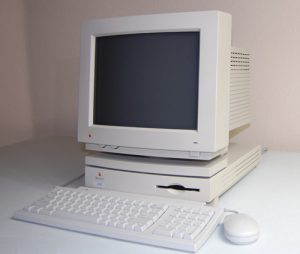
Our first home computer was a Macintosh Performa 467 purchased Jan. 1, 1994.

When I became a newspaper reporter in 1977, our exposure to computers was Compugraphic typesetting equipment. We would write our stories on a long piece of paper not unlike the roll that comes out of a lot of hand towel machines in public restrooms. If we had to insert a paragraph into a story, we would literally “cut” the paper and “paste” the new one in it using rubber cement. That practice gave us the modern day terminology of “cut and paste” and probably gave a lot of reporters a chemical dependency from huffing too much rubber cement (and no, that’s not where the “Huff Post” online got its name). Young women who were very fast typists would spend all day retyping our stories onto long strips of paper about three-quarters of an inch wide that could be read by the Compugraphic equipment, which then output them as type onto photosensitive paper, which was developed, waxed and stuck down on a layout sheet.

Around 1980 the semi-weekly newspaper at which I worked in Wharton, Texas, installed a computer system which consisted of several “dumb” terminals linked to a central computer, which in turn was linked to the Compugraphic equipment. One of my jobs every morning was inserting a 12-inch floppy disk (this was when they were really floppy and not protected by a hard plastic case) into the computer so everyone’s terminals could come to life. You notice the name Compugraphic keeps popping up. They had a virtual monopoly on newspaper typesetting equipment back in that era. A few years later, David Moran, our tech guru at the Attaway Newspaper Group in the Houston suburbs, found out a way to beat the system. He came up with a program that would interface a TRS-80 computer from Radio Shack with the Compugraphic typesetters, making every reporter or editor a typesetter for a fraction of the cost. They were decried as the “Trash 80” by devotees of computers that are also nowhere to be found today, but they taught me a lot about modern-day computing. Plus, I had fun playing games on them when I wasn’t working.

The term “home computer didn’t become ubiquitous until a decade later. We bought our first computer on Jan. 1, 1994, at the Sam’s Club in Daytona Beach. It was a Macintosh Performa 467, which came with 4 megs (that’s megs, not gigs) of RAM and a 160-meg (again, meg, not gig) hard drive. We had decided on the purchase a few months earlier, but had to wait to arrange financing. I spent the fall of 1993 reading MacUser magazines and MacWarehouse catalogs from cover to cover, frontwards and backwards, devouring everything there was to be learned about this new marvel that was joining our household.

So much has changed in the world of computing in the nearly quarter-century since. It’s not just that I’m writing this blog post on a MacBook Pro that’s sitting on my lap while I’m relaxing on my living-room couch. It’s the very nature of how computers (How many people use them to “compute” anything these days?) have changed the very nature of how we live. I heard recently that when we were kids, we would write our deepest thoughts in a diary and get mad if somebody read them. Nowadays, we write them in a blog or on Facebook and get mad if somebody doesn’t read them.

The “more computing power than took man to the moon” was last used to describe a home device about 20 years ago, which as I recall was the Palm Pilot (one more device for the scrap heap of technology history). Nowadays, your iPhone (or Android device if you don’t appreciate the finer things in life) is an honest-to-goodness supercomputer. Just be careful if you’re holding a supercomputer in the palm of your hand while you’re near a toilet. At least today, the bag of rice it will take to dry it out isn’t anywhere near as large as the one that would have been required in 1969.


Whatever happened to the Old West?

We moved to Florida the summer I turned 8 years old. It goes without saying that Florida was a much different place in 1964. But unless you experienced Florida before the arrival of Walt Disney World and everything that followed, you have no idea how much.

The Interstate Highway System was still in the early stages of construction, so highways went from town to town and through, not around them. Travel was at a much slower pace, and tourist attractions were something you might encounter along the side of the road. There were still major tourist attractions spread across Central Florida; Walt Disney didn’t invent the sunshine, after all. But most of those are gone now, lost to the inability to compete with the glitz of Mickey and friends.
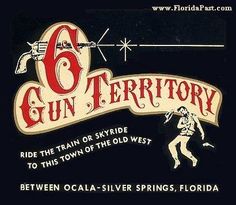
6 Gun TerritoryOne of my favorite attractions was Six Gun Territory just east of Ocala. It was a replica of an Old West town, where you’d stroll the dirt streets and visit the saloon, the general store, the school house, and so on. The chief attraction was live gunfights on the street with lawmen and desperadoes shooting very loud blanks at each other from their six-shooters and dying some Hollywood-worthy deaths.

Six Gun Territory isn’t there anymore. I believe I heard it’s an RV park now. Of course, Six Gun Territory was never really there; back in the 1880s there wasn’t much south of the Florida Panhandle except alligators and mosquitoes and a few coastal communities. But what if Six Gun Territory had been real? What would it be like today? I think it would have “grown up” to become a place like Wallace, Idaho.

Wallace, just 90 minutes east of Spokane along Interstate 90, is a town that has embraced, rather than run from, its past. Like other towns in northern Idaho’s Silver Valley, Wallace was built on the twin pillars of the Old West’s economy: mining and the railroad. We’ve been to Wallace twice this summer and spent our wedding anniversary there last weekend.

Wallace and Kellogg, the next town to the west, charted different paths when a downturn in the mining industry crippled the local economy. City fathers in Kellogg took advantage of the mountain at their doorstep to develop ski runs and a gondola ride up to the top. There was only one problem. The gondola reached the bottom too far from downtown, and as a result visitors to Silver Mountain had no reason to leave the resort area. As a result, the downtown area became little more than a collection of boarded-up commercial buildings.

OasisOn the other hand, Wallace as a whole has embraced the tourism industry and found success. You might say that’s it’s embraced tourism for a long time; after all, it still had an active bordello downtown until 1988. Yes, 1988. That space is now the Oasis Bordello Museum, with “eye-opening guided tours (and) three floors of historical artifacts.” Those artifacts weren’t dug up, but consists of things that are where they were found when the last of the ladies left in a hurry in 1988.

Despite a year-round population of less than 1,000 people, I didn’t see a single boarded-up storefront downtown. It could have turned out much different. A half century ago, the Federal Highway Administration was planning Interstate 90 through the Silver Valley and its initial plan was to take the route through the center of Wallace. The town’s leaders liked Wallace the way it was, and every building in downtown Wallace was added to the National Register of Historic Places. The government was forced to re-route the interstate to an elevated viaduct skirting the northern edge of town. That viaduct famously collapsed thanks to the magic of Hollywood special effects in the 1997 volcano movie “Dante’s Peak.”
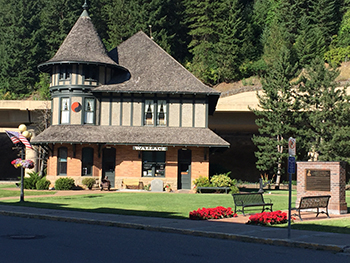
DepotToday Wallace is a compact, walkable downtown with something for everybody. There’s lots of brick buildings erected in the aftermath of the Great Fire of 1910. There’s lots of nice touches such as the old First National Bank building with the analog time and temperature sign. The former Northern Pacific Railway depot has been restored and converted into a railroad museum. The day we were there, “Colonel Wallace” was available to give us a personal tour. We stayed in the Ryan Hotel, which is billed as the oldest continuously operating “legitimate” hotel, dating to 1903. The lobby is on the second floor, up some 20 stairs (no elevator), but once there you’re greeted by a sitting room that looks virtually unchanged since the early 1900s. A word of caution: no air conditioning, no television, no radio, again just like the old days. Just down the street is Tabor’s Emporium, with two floors of mid-century modern antiques and collectibles. A block away, at the intersection with the manhole cover (and photo opportunity) designated “The Center of the Universe,” is Johnson’s Gems, featuring handmade jewelry, sports memorabilia and other collectibles.

The Sierra Silver Mine Tour departs from downtown, and lets you go underground for a tour led by a former miner who fires up some of the old equipment to give you a glimpse at conditions several stories underground in earlier times. The Sixth Street Melodrama offers family entertainment as the fair maiden is rescued from the dastardly bad man and the farm is saved. The town also hosts the Wallace District Mining Museum, Silver Streak Zipline Tours, and is the trailhead for hikes up into the great outdoors and the starting point for the Trail of the Coeur d’Alenes, a 70-mile (mostly downhill) paved bicycle and pedestrian trail along a former railroad bed. We had lunch at The Fainting Goat: Wine Bar, Tap Room and Casual Fine Dining. We both had the asparagus and shrimp salad, made with asparagus, shrimp, field greens balsamic vinaigrette, spiced hazelnuts, heirloom tomatoes and poached egg. Yes, in Wallace, Idaho.

I’m not saying that Wyatt Earp would trade in his shot of deadeye whiskey for a glass of Viognier if he were to ride his (Ford) Mustang into Wallace today, but I do think he would be right at home in this modern version of an Old West town.
33 years as a trophy husband

When people ask me how I met my wife, I say with a chuckle, “She was a newspaper editor who hired me not once, but twice!” But that doesn’t begin to tell the story of how I went in for a job interview in Friendswood, Texas, in 1981 and less than three years later ended up married to the boss and the stepfather of two sons.

It’s true that Annie was the editor overseeing two semi-weekly newspapers and one weekly in Friendswood, Pearland and Alvin, Texas. I was “between opportunities” that summer, sleeping on my brother’s couch and working as an expediter in the kitchen at a nearby Bennigan’s restaurant. I had submitted my resume to the Daily Citizen in nearby Clear Lake City, but they had no openings. But when Annie transferred to the editor vacancy at the newly acquired semi-weeklies, she found herself going through the Citizen’s  resumes when she was looking for a reporter.

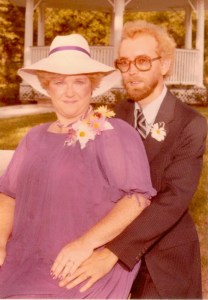
Wedding day, July 28, 1984.

There were no  fireworks in the first meeting, not that anyone was expecting any. I had a good interview and got the job. I was a good reporter and photographer and proved my worth to the organization. We became friends as well as co-workers, and would always laugh on Monday mornings as we shared the latest exploits of our brothers Dan and Stan. When Annie left the next year to work on a book project, I was promoted into her position. When she returned from her sabbatical, the only job in the organization was at the Cleveland Advocate, a job that was available because no one else in the organization would touch it with the proverbial 10-foot pole. The previous editor got the newspaper sued for libel over accusations that the superintendent of schools outfitted his hunting cabin with “harvest gold bathroom fixtures” and other accoutrements at taxpayer expense. The accusations divided the community. Whose side you were on in the dispute could be seen in which side of the aisle you sat on Sunday mornings at the First Baptist Church. A “shopper” publication started up that took all the grocery store ads, which, pardon the pun, are the “bread and butter” of small town newspapers. It wasn’t anybody’s dream job.

Annie liked a challenge, and one of her challenges at the Advocate was a reporter who happened to be the nephew of the daily columnist at the Houston Post.  But the nephew was not his uncle, a situation that became painfully clear to Annie. Meanwhile, back in Friendswood, my publisher was leaving, the new publisher wanted to hire her own editor, and some of the honchoes in the company had a great idea over a round of golf: we’ll transfer Garry up to Cleveland to work for Annie. It would solve Annie’s problem and it would avoid a messy situation in Friendswood. There was only one problem: Garry was happy where he was and didn’t want to go.

Not too many weeks later, the decision was made anyway. In the newspaper business, someone can always find ways to question your judgment on a particular issue and use it as the reason to fire you. So I called Annie from a payphone that night from a local establishment that served adult beverages and asked, “Is that job still open?” It was, and I soon packed a U-Haul trailer and moved to Cleveland, about a half-hour northeast of Houston.

We found ourselves in Cleveland as two lonely people who spent a lot of time together at work and also away from the office. There weren’t a lot of romantic prospects there for either a single mom with two kids who worked long hours or a shy young man who had never had a lot of success with courtships. We socialized a lot and went to events as friends, usually with her sons.  Annie points out that she always paid her own way. The boys would spend every other weekend with their father in Houston, and I found myself spending more time with Annie. The boys had an Atari game machine hooked up to the television, and Annie let me play their video games.

I won’t go into the details of when we knew we were more than just friends. Let’s just say the light bulb went on and the romance developed. We progressed past that first Christmas when I said, “I love you,” and she said, “No, you don’t.” We dated for several months “under the radar” in that small town with know one knowing, with the exception of the boys, her next-door neighbor and a couple of trusted friends. The boys, who were 8 and 14, tried to scare me off at first, but I knew the game they were playing and wasn’t going to let them win.

I was always a bit of a slow learner in matters of the heart, so that courtship could have continued for a long time if it wasn’t the rental house that became available that spring. We were walking around the neighborhood one Saturday when we saw a “For Rent” sign on a three-bedroom brick house with a fenced back yard. There weren’t many rental units in Cleveland other than apartments and mobile homes. This house was a gem. I said, “Hey, we could get married at the end of next month when the house becomes available and move right in!” Not the most romantic proposal, I realize, but it got the job done.  After some negotiation, we decided on July 28 as a wedding date. The run-up to the wedding didn’t come without some angst, however. Our son was playing youth baseball that summer and his team came within one inning of advancing to the state championship game to be played in Texarkana on our wedding day. Fortunately, we never had to make that call.

That was 33 years ago. We still wear our matching wedding bands from the fine jewelry department at JCPenney, although I have supplemented hers with a ring that includes diamonds.  She’s been “the wind beneath my wings” all this time, and always saw the potential in me even when I didn’t see it myself. She still does. Thanks for 33 great years, Annie. I love you.


“Leave It to Beaver” meets real life

My parents tried very hard to be good parents. That’s a sentiment that goes without saying for most people, but it’s something that I didn’t fully appreciate until I was grown and my parents were no longer around for me to acknowledge.

My parents were married in 1952. My dad was a Korean War veteran from Detroit whose college education in accounting was interrupted by the draft. My mother was a high school dropout from southeastern Kentucky who was working in a steam laundry. (How they met, courted and married is material for another blog post.) Neither one was, shall we say, sophisticated.

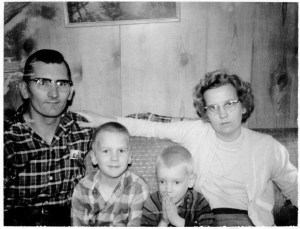
The Matlow family in the early 1960s taken with a newfangled camera called a “Polaroid.” I appear to be in prayer about something.

The summer I turned 5 the family, which included my brother, who was three years older than me, moved from a row house in Cumberland, Kentucky, to a suburban home in South Bend, Indiana. My dad was 33 and my mom was almost 35. It wasn’t quite “The Beverly Hillbillies” as we had no “cee-ment pond,” but they did leave Appalachia for a home in the land of “Leave It to Beaver” and “Father Knows Best.” Those TV shows, with June Cleaver and Margaret Anderson fixing dinner in pearls and high heels, were presented to America as real life. If you were living in this new post-war era of tract houses and garages and back yards, this was what your life was supposed to be like.

Can you remember what your life was like when you were in your early and mid 30s? I think back to what was going on in my life, with the pressures of work and family, and think to myself, this is the stage of my life my parents were in during the three years we lived in Indiana. They had been married about 10 years and uprooted their lives to provide a better one for their children.

Through the lens of 20/20 hindsight, I can tell how hard they tried. One thing they did was buy a console stereo. That was nothing unusual by itself. Advancement in technology, with something the Japanese invented called “transistors” replaced tubes in radios, and 33 rpm records replaced the old 78s. It was a revolution in home entertainment. What was unusual was what they purchased to play on their new stereo. There was a multi-album collection of classical music entitled “The World’s Most Beautiful Music.” There were show tunes: “West Side Story,” “Camelot,” “Brigadoon.”

This was not my parents’ music. She was a lifelong devotee of country music and gospel quartets, and the radio that played in the house in the mornings provided the music of Frank Sinatra and Perry Como. Decades later the light bulb went on over my head: they were trying to do the right thing and provide culture for their sons. And it worked, actually. I can’t tell you how many times I listened to the original Broadway soundtrack of “West Side Story” and “Camelot,” following the story in the liner notes.  And one of my two jobs today is doing marketing for the Spokane String Quartet.

But the music is just half the story. The other half comes courtesy of letters from Encyclopedia Britannica that I found after my mother died. I mentioned that she dropped out of high school and went to work during World War II.  An older cousin told me that Mother’s older sister was considered to be “the smart one” who received favored treatment from her parents, while my mother didn’t get the encouragement. But my mother wanted to be a better person. When we lived in Indiana, she went to night school and earned her GED. The whole family went downtown on those nights and had dinner at McDonald’s, and my dad took me and my brother to the library to read and check out books while my mother was in school.

In the summer of 1960, while we were still in Kentucky, my parents purchased a set of Encyclopedia Britannica. The contract says the purchase price was $434 (a small fortune in 1960 dollars), payable $10 down and $18 a month. With the encyclopedias came a sheet of “Library Research Service” stamps, each good for a custom research report prepared especially for you.

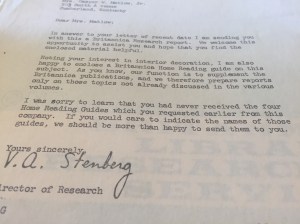
When I was going through these old papers that my mother retained over the next half century and four different houses, what brought tears to my eyes was a letter from V.A. Sternberg, director of research at the Encyclopedia Britannica Library Research Service in Chicago. “Dear Mrs. Matlow,” said the letter dated Feb. 6, 1961, “In answer to your letter of recent date I am sending you with this a Britannica Research report.” Still stapled to the letter was a 21-page typewritten report on “Home Freezing of Foods.” The letter continued, “Noting your interest in interior decoration, I am also happy to enclose a Britannica Home Reading guide on this subject.”

Then came the kicker: “I am sorry to learn that you had never received the four Home Reading Guides which you requested earlier from this company.” To sum up, here was a high school dropout in Appalachia with a new set of encyclopedias that were purchased to help provide a better life for her children. But she wanted to be a better person as well, so she ordered some educational materials, but they never came. Can you imagine the disappointment of a person who took the time to craft a letter to the big company seeking knowledge, checking the mailbox every day, only to have the materials never arrive? But Mother didn’t give up. She requested another publication, and happened to mention the earlier request. And along with the interior decoration guide (maybe to make your home look like the Cleavers’ home?) were publications on business law and religions of the world.

Our family life never turned out like Beaver and Wally’s, but in reality no one’s life ever does. But through the dusty publications and letters kept in a box in the closet, I can say for a fact that it was not because my parents didn’t try. And I am thankful to them for that.