“Leave It to Beaver” meets real life

My parents tried very hard to be good parents. That’s a sentiment that goes without saying for most people, but it’s something that I didn’t fully appreciate until I was grown and my parents were no longer around for me to acknowledge.

My parents were married in 1952. My dad was a Korean War veteran from Detroit whose college education in accounting was interrupted by the draft. My mother was a high school dropout from southeastern Kentucky who was working in a steam laundry. (How they met, courted and married is material for another blog post.) Neither one was, shall we say, sophisticated.
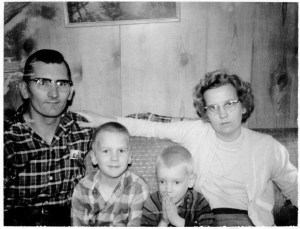
The Matlow family in the early 1960s taken with a newfangled camera called a “Polaroid.” I appear to be in prayer about something.

The summer I turned 5 the family, which included my brother, who was three years older than me, moved from a row house in Cumberland, Kentucky, to a suburban home in South Bend, Indiana. My dad was 33 and my mom was almost 35. It wasn’t quite “The Beverly Hillbillies” as we had no “cee-ment pond,” but they did leave Appalachia for a home in the land of “Leave It to Beaver” and “Father Knows Best.” Those TV shows, with June Cleaver and Margaret Anderson fixing dinner in pearls and high heels, were presented to America as real life. If you were living in this new post-war era of tract houses and garages and back yards, this was what your life was supposed to be like.

Can you remember what your life was like when you were in your early and mid 30s? I think back to what was going on in my life, with the pressures of work and family, and think to myself, this is the stage of my life my parents were in during the three years we lived in Indiana. They had been married about 10 years and uprooted their lives to provide a better one for their children.

Through the lens of 20/20 hindsight, I can tell how hard they tried. One thing they did was buy a console stereo. That was nothing unusual by itself. Advancement in technology, with something the Japanese invented called “transistors” replaced tubes in radios, and 33 rpm records replaced the old 78s. It was a revolution in home entertainment. What was unusual was what they purchased to play on their new stereo. There was a multi-album collection of classical music entitled “The World’s Most Beautiful Music.” There were show tunes: “West Side Story,” “Camelot,” “Brigadoon.”

This was not my parents’ music. She was a lifelong devotee of country music and gospel quartets, and the radio that played in the house in the mornings provided the music of Frank Sinatra and Perry Como. Decades later the light bulb went on over my head: they were trying to do the right thing and provide culture for their sons. And it worked, actually. I can’t tell you how many times I listened to the original Broadway soundtrack of “West Side Story” and “Camelot,” following the story in the liner notes.  And one of my two jobs today is doing marketing for the Spokane String Quartet.

But the music is just half the story. The other half comes courtesy of letters from Encyclopedia Britannica that I found after my mother died. I mentioned that she dropped out of high school and went to work during World War II.  An older cousin told me that Mother’s older sister was considered to be “the smart one” who received favored treatment from her parents, while my mother didn’t get the encouragement. But my mother wanted to be a better person. When we lived in Indiana, she went to night school and earned her GED. The whole family went downtown on those nights and had dinner at McDonald’s, and my dad took me and my brother to the library to read and check out books while my mother was in school.

In the summer of 1960, while we were still in Kentucky, my parents purchased a set of Encyclopedia Britannica. The contract says the purchase price was $434 (a small fortune in 1960 dollars), payable $10 down and $18 a month. With the encyclopedias came a sheet of “Library Research Service” stamps, each good for a custom research report prepared especially for you.
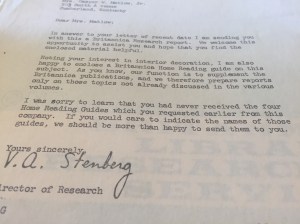
When I was going through these old papers that my mother retained over the next half century and four different houses, what brought tears to my eyes was a letter from V.A. Sternberg, director of research at the Encyclopedia Britannica Library Research Service in Chicago. “Dear Mrs. Matlow,” said the letter dated Feb. 6, 1961, “In answer to your letter of recent date I am sending you with this a Britannica Research report.” Still stapled to the letter was a 21-page typewritten report on “Home Freezing of Foods.” The letter continued, “Noting your interest in interior decoration, I am also happy to enclose a Britannica Home Reading guide on this subject.”

Then came the kicker: “I am sorry to learn that you had never received the four Home Reading Guides which you requested earlier from this company.” To sum up, here was a high school dropout in Appalachia with a new set of encyclopedias that were purchased to help provide a better life for her children. But she wanted to be a better person as well, so she ordered some educational materials, but they never came. Can you imagine the disappointment of a person who took the time to craft a letter to the big company seeking knowledge, checking the mailbox every day, only to have the materials never arrive? But Mother didn’t give up. She requested another publication, and happened to mention the earlier request. And along with the interior decoration guide (maybe to make your home look like the Cleavers’ home?) were publications on business law and religions of the world.

Our family life never turned out like Beaver and Wally’s, but in reality no one’s life ever does. But through the dusty publications and letters kept in a box in the closet, I can say for a fact that it was not because my parents didn’t try. And I am thankful to them for that.
Brotherly love

I have a birthday coming up in about three weeks. If I don’t get run over by a bus between now and then, the number that I will put in the “age” blank on forms that I fill out from here on out will be higher than any number my late brother was ever able to write in.

I remember when my mother turned 82 in 2008, she said with pride, “At least I outlived Ellen.” Ellen was her older sister, who died in 2006 a week shy of her 82nd birthday.  My mother didn’t outlive Ellen by long; she died two months later.

I never had any desire to outlive my brother, who was three years older than me. As I was growing up, Stan was my hero. When I was 2 or 3 years old, I would stand at the door and cry when he went off to school in the morning and I had to stay home. But being a good brother he would try to teach me everything he learned when he got home.

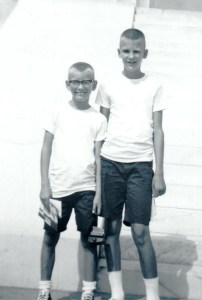
Garry and Stanley Matlow in Washington, D.C., in the summer of 1965.

Like a lot of older siblings, Stan often made me the victim in our relationship, whether on purpose or by happenstance. Take The Sled Incident, for example. We lived in South Bend, Indiana, when I was in kindergarten, first grade and second grade. We had what I remember as a great sledding hill a short walk from our house. Stan (who would have been in third- or fourth-grade at the time)  and his friends got the idea, probably from a cartoon on TV, that we would all ride down the hill on the same sled. I would be on the back of the sled, one end of a rope tied around my waist and the other end tied around a tree at the top of the hill. We would all take off down the hill, and when the rope went taut, the sled would stop dead, sort of like when the coyote runs off the cliff and stops in mid-air immune to the forces of gravity. Of course you know what happened. The sled loaded with four or five kids takes off down the hill, picks up speed and the rope goes taut, yanking me off the back of the sled. I believe I still have rope burns around my waist to this very day.

Around the same era was The Swing Set Ring Incident. We were visiting some of my parents’ friends and Stan and I were playing in the back yard. He picked up one of those swinging rings from the swings and threw it at me. A metal barb caught me square in the back of the head and  I began bleeding like a stuck pig. We went quickly into the house. My mother sees me, crying like a baby, and Stan following along behind, trying to catch my blood in cupped hands as it flowed out of my head. “Stan, honey,” she said. “What happened to you?” Once the facts were determined, I was rushed to the emergency room for the first and only time I had to get stitches as a child.

This kind of behavior continued into our adult lives. When I was 22, he took over my apartment when I moved to another town for a job and he ended up sticking me with a very expensive phone bill. I remember complaining to a girl whom I was dating at the time that I expected more out of family. I believe she was an older sibling, because her response was, “If you can’t screw over your family, than who can you screw over?”

I’m sure there were many more instances of screwing over the younger brother that he took to the grave. I am fortunate that he never figured out that my Social Security number was just one digit different from his.

I stuck with Stan over the almost six decades that we shared the planet together.  In our young adulthood we were drinking buddies, going to Astros games or professional wrestling together when we lived in Houston, or running out to a bar the night in 1981 that we heard on the late news that singer Harry Chapin had been killed in a car wreck so we could knock back one in his memory. We were in our 20s then, and I will readily confess that I did a lot of stupid things in my 20s.  Stan never fully realized that not everyone drank as much as he did, and that his drinking behavior was not considered to be normal in society.

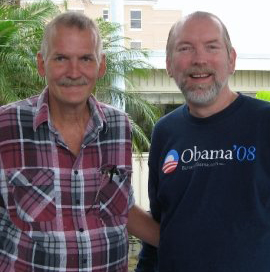
The Matlow brothers in November 2008.

Stan married three times and fathered sons with two of his wives. I married once and have two stepsons, and celebrate my 33rd wedding anniversary a week before my birthday. Stan’s marriages didn’t last long, with alcohol abuse playing a big role in the last two divorces. He still was able to hold jobs until he was close to 50, first as a waiter or restaurant manager and later in an auto parts store.

The year he turned 51 I tried to “rescue” him. He was living in his ex-wife’s basement at the time, and recently had a wine bottle cracked over his head in an argument with one of his sons. I figured that was no place to get sober, so I paid to have him fly to Spokane to live with us. I learned that summer that he was in a cycle of holding a job until he got a paycheck, then taking it to the closest liquor store and exchanging it for all the alcohol it would buy. Then he would go on a bender and drink until he blacked out, then repeat the cycle. That summer his boss, a recovering alcoholic, would take him to AA meetings, but by that time Stan was well-versed in the game of saying whatever he was supposed to say so he could ultimately get what he wanted.

I also learned a lot about addiction that summer. I learned that he still had hopes and dreams. As I tried to help him find a job, I asked what he wanted to do with the rest of his life. He said what he really wanted to do is wait tables. He really loved people and enjoyed interacting with them. I also learned that deep inside, he really wanted to better himself. He bought some of those teeth-whitening strips, and I remember how genuinely disappointed he was when they didn’t work like he expected them to do.

In his later years, a lifetime of substance abuse led to dementia, kidney disease and liver disease. The last couple years of his life he spent in Tallahassee living in a homeless shelter. The people who ran the shelter remembered what a nice man he was, not like a lot of the others. When they had a workday and he was unable to help out because of swollen feet or walking difficulties, he apologized and was sincerely sorry he wasn’t able to do his part and help out. That’s the kind of person my brother was: a good person, shackled by addiction. He left his world Aug. 18, 2014, the last member of my immediate family, leaving a void in my life that I’m reminded of whenever Kentucky basketball season rolls around or a Meat Loaf song comes on the radio.

Once a writer, always a writer

For most of my life I have considered myself to be a good writer.

When I was in eighth grade, I had a book report due for English class. There was only one problem: I hadn’t read a book for the assignment. So I sat in class and wrote a book report for a nonexistent book, The Mickey Mantle Story. I dredged up all the facts I could recall about my baseball hero and received a “B” for my efforts.

By the time I was in high school I was frequent thorn in the side of the featured columnist for our local newspaper, “Today, Florida’s Space Age Newspaper.” Jerry Greene had the poor judgment to open letters from me and print some of the ones he thought were amusing. I was a prolific writer of letters to the editor, and the parents of my friends were always saying, “Garry, you should write a letter to Today about…”

Watergate came along, and everyone wanted to be the next Bob Woodward or Carl Bernstein. I packed off to the University of Florida, where I majored in journalism and minored in political science. I spent the next 18 years as a reporter, photographer, news editor and/or copy editor for weekly, semi-weekly and daily newspapers in Texas and Florida. Writing was always a big part of my job. I enjoyed being able to do an interview or attend a city or county government meeting and distilling what happened into very readable copy.

So what happened? In 1995, seeking a climate with four seasons, cool nights, no mosquitoes and fewer retirees, my wife and I changed corners of the country and moved 3,000 miles to Spokane, Washington. We left two good jobs for the move, and my wife quickly found work in public relations. As for me, it turned out that the local newspaper, the Spokesman-Review, was such a great place to work that no one ever left. And when someone did leave, they weren’t hiring middle aged white males to replace them. Turned out that they had plenty of those already.

So I moved over to “the dark side” and looked for work in public relations. I was an advertising proofreader and copy editor for a computer retailer and did marketing for an engineering company before going back to school for a certificate in public relations. That helped me get a job with the local chapter of Ronald McDonald House Charities, where I was hired as an administrative assistant but soon was doing quite a bit of communications and graphic design work. My next job was as communications specialist for the Arc of Spokane, where I did quite a bit of writing and graphic design.

I started my current job with the Alzheimer’s Association 11 years ago. I started out as communications and program assistant (a fancy name for administrative assistant) and over the years took on more and more administrative and clerical duties. And soon those administrative tasks left little or no time or energy for writing, despite stories in my head that need to be shared.

I was complimenting a friend today on her blog and her storytelling ability and mentioned how much I missed writing. I said I had even gone so far as to buy a domain and set up a WordPress blog. Her succinct reply was, “Get to it.”

So here I am. Writing is like falling off of a bicycle; if you’ve done it once, you never forget how to fall off again (or something like that). I plan to share some stories and accumulated wisdom from my six decades on this planet, as well as comment on whatever strikes my fancy. Together we’ll see if I’m still as good of a writer as I remember.